
Flipping a science education course for pre-service teachers
A case of Finnish-Palestinian collaboration
DOI:
https://doi.org/10.31129/LUMAT.14.2.3062Keywords:
Flipped pedagogy, Flipped classroom, Pre-service teachers, science teachers, Teacher education, PalestineAbstract
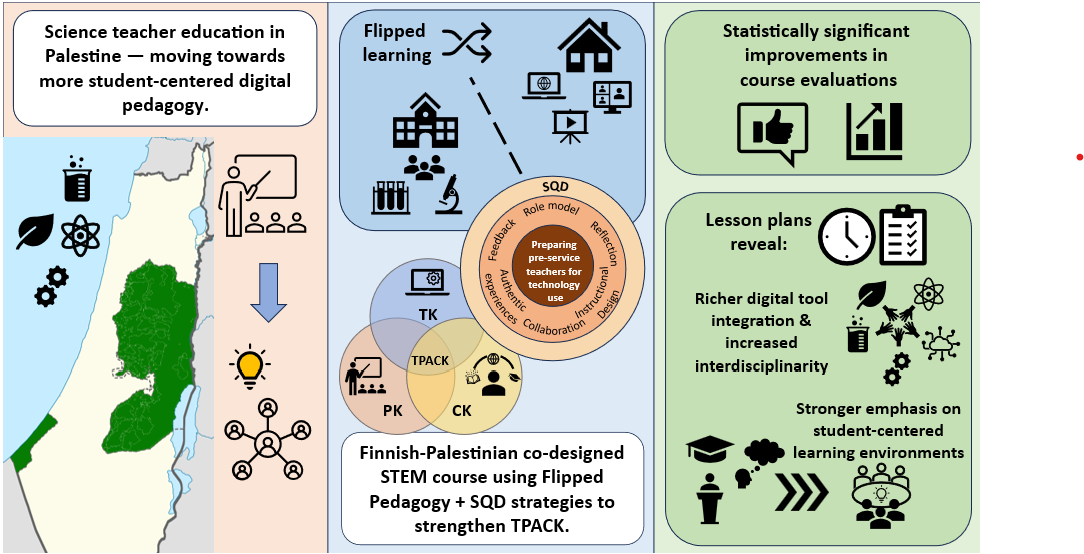
This case study aimed at exploring how pre-service science teachers perceived a jointly developed course based on flipped pedagogy and how it supported their learning. For this purpose, quantitative data of how pre-service science teachers perceived the course was collected through a standardized instrument, while qualitative data was collected from lesson plans that they developed before and after the course. Target group consisted of 14 students who are enrolled in their pre-service teacher education diploma program. Quantitative data was analyzed using Mann-Whitney U-Test comparing the target group to previous two years (N = 29). The qualitative data was analyzed through deductive content analysis based on Technological Pedagogical Content Knowledge framework. Quantitative results revealed that pre-service teachers assessed the newly designed course very positively and statistically significant differences were found. while qualitative results show a shift from the lecturing type teaching toward more student-centered learning activities in the lesson plans, such as collaborative and interactive group work. Also, results pointed out deeper student understanding of the STEM content knowledge with concrete examples of important scientific concepts and ideas and paying more attention to alternative conceptions. Moreover, final versions of the lesson plans included explicit and rich use of digital technology elements such as links to videos and use of specialized tools and applications for science education. The results strongly suggest that flipped pedagogy is a promising model and encourage its further use for science teacher training.
References
Abdelmoneim, R., Jebreen, K., Radwan, E., & Kammoun-Rebai, W. (2024). Perspectives of teachers on the employ of educational artificial intelligence tools in education: The case of the Gaza Strip, Palestine. Human Arenas, 1-30. https://doi.org/10.1007/s42087-024-00399-1 DOI: https://doi.org/10.1007/s42087-024-00399-1
Akçayır, G., & Akçayır, M. (2018). The flipped classroom: A review of its advantages and challenges. Computers & Education, 126, 334-345. https://doi.org/10.1016/j.compedu.2018.07.021 DOI: https://doi.org/10.1016/j.compedu.2018.07.021
Baran, E., Canbazoglu Bilici, S., Albayrak Sari, A., & Tondeur, J. (2019). Investigating the impact of teacher educa-tion strategies on preservice teachers' TPACK. British Journal of Educational Technology, 50(1), 357–370. https://doi.org/10.1111/bjet.12565 DOI: https://doi.org/10.1111/bjet.12565
Barr, R. B., & Tagg, J. (1995). From Teaching to Learning — A New Paradigm for Undergraduate Education. Change: The magazine of Higher Learning, 27(6), 12–26. https://doi.org/10.1080/00091383.1995.10544672 DOI: https://doi.org/10.1080/00091383.1995.10544672
Bergmann, J., & Sams, A. (2012). Flip your classroom: Reach every student in every class every day. Internation-al society for technology in education.
Bond, M. (2020). Facilitating student engagement through the flipped learning approach in K-12: A systematic review. Computers & Education, 151, 103819. https://doi.org/10.1016/j.compedu.2020.103819 DOI: https://doi.org/10.1016/j.compedu.2020.103819
Cam, A., Arslan, H. O., & Cigdemoglu, C. (2022). Flipped Learning Model - Learning Style Interaction: Supporting Pre-service Teachers on Science Teaching Methods and Personal Epistemologies. Science Education Interna-tional, 33(3), 323–334. https://doi.org/10.33828/sei.v33.i3.8 DOI: https://doi.org/10.33828/sei.v33.i3.8
Canbazoglu Bilici, S., Guzey, S. S., & Yamak, H. (2016). Assessing pre-service science teachers’ technological peda-gogical content knowledge (TPACK) through observations and lesson plans. Research in Science & Techno-logical Education, 34(2), 237–251. https://doi.org/10.1080/02635143.2016.1144050 DOI: https://doi.org/10.1080/02635143.2016.1144050
Chai, C. S., Koh, J. H. L., & Tsai, C. C. (2013). A Review of Technological Pedagogical Content Knowledge. Educa-tional Technology & Society, 16(2), 31–51.
Chai, C.S. (2019) Teacher Professional Development for Science, Technology, Engineering and Mathematics (STEM) Education: A Review from the Perspectives of Technological Pedagogical Content (TPACK). Asia-Pacific Edu Res 28(1), 5–13. https://doi.org/10.1007/s40299-018-0400-7 DOI: https://doi.org/10.1007/s40299-018-0400-7
Cheng, S.-C., Hwang, G.-J., & Lai, C.-L. (2022). Critical research advancements of flipped learning: a review of the top 100 highly cited papers. Interactive Learning Environments, 30(9), 1751–1767. https://doi.org/10.1080/10494820.2020.1765395 DOI: https://doi.org/10.1080/10494820.2020.1765395
Cox, S., & Graham, C. R. (2009). Diagramming TPACK in Practice: Using an Elaborated Model of the TPACK Framework to Analyze and Depict Teacher Knowledge. TechTrends, 53(5), 60–69. https://doi.org/10.1007/s11528-009-0327-1 DOI: https://doi.org/10.1007/s11528-009-0327-1
Dweikat, K. A. J., & Raba, A. A. (2019). English as a foreign language (EFL) teachers’ perceptions of flipped class-room model in Palestine. Islamic University-Gaza Journal of Educational and Psychological Sciences, 27(3), 29–47.
Elhawa, H. A. (2023). Developing Approaches to CALL Teacher Education in Palestine: Problems, Possibilities, and Paradigm Shifts. In Tafazoli, D. & Picard, M. (eds.), Handbook of CALL Teacher Education and Profes-sional Development: Voices from Under-Represented Contexts (pp. 261-277). Singapore: Springer Nature Singapore. https://doi.org/10.1007/978-981-99-0514-0_16 DOI: https://doi.org/10.1007/978-981-99-0514-0_16
Elo, S., & Kyngäs, H. (2008). The qualitative content analysis process. Journal of Advanced Nursing, 62(1), 107–115. https://doi.org/10.1111/j.1365-2648.2007.04569.x DOI: https://doi.org/10.1111/j.1365-2648.2007.04569.x
Farrah, M., & Qawasmeh, A. (2018). English Students’ Attitudes Towards Using Flipped Classrooms in Language Learning at Hebron University. Research in English Language Pedagogy (Online), 6(2), 275–294. https://doi.org/10.30486/relp.2018.542708
Fragkaki, M., Maliq, M. S. A., Bed, S. F. A. A., Farhaneh, S. Z., Najdi, R. E., & Hawamdeh, M. M. K. (2015). ICT in Palestinian Education: Emancipatory Action Research towards 21st C. Skills. Retrieved January 20th from https://www.researchgate.net/publication/278327873_ICT_in_Palestinian_Education_Emancipatory_Action_Research_towards_21st_C_Skills
Freeman, S., Eddy, S. L., McDonough, M., Smith, M. K., Okoroafor, N., Jordt, H., & Wenderoth, M. P. (2014). Ac-tive learning increases student performance in science, engineering, and mathematics. Proceedings of the National Academy of Sciences, 111(23), 8410-8415. https://doi.org/10.1073/pnas.1319030111 DOI: https://doi.org/10.1073/pnas.1319030111
Fung, C. H., Poon, K. K., & Ng, S. P. (2022). Fostering student teachers’ 21st century skills by using flipped learn-ing by teaching in STEM education. Eurasia Journal of Mathematics, Science and Technology Education, 18(12). https://doi.org/10.29333/ejmste/12728 DOI: https://doi.org/10.29333/ejmste/12728
Gong, J., Cai, S., & Cheng, M. (2024). Exploring the Effectiveness of Flipped Classroom on STEM Student Achievement: A Meta-analysis. Technology, Knowledge and Learning, 29(2), 1129–1150. https://doi.org/10.1007/s10758-023-09700-7 DOI: https://doi.org/10.1007/s10758-023-09700-7
Graham, C. R. (2011). Theoretical considerations for understanding technological pedagogical content knowledge (TPACK). Computers & Education, 57(3), 1953–1960. https://doi.org/10.1016/j.compedu.2011.04.010 DOI: https://doi.org/10.1016/j.compedu.2011.04.010
Harasim, L. (2006). A history of e-learning: Shift happened. In Weiss, J., Nolan, J., Hunsinger, J. & Trifonas, P. (eds.), The international handbook of virtual learning environments (pp. 59-94). Dordrecht: Springer Neth-erlands. https://doi.org/10.1007/978-1-4020-3803-7_2 DOI: https://doi.org/10.1007/978-1-4020-3803-7_2
Hsu, Y.Y., & Lin, C.H. (2020). Evaluating the effectiveness of a preservice teacher technology training module incorporating SQD strategies. International Journal of Educational Technology in Higher Education, 17(1), 31. https://doi.org/10.1186/s41239-020-00205-2 DOI: https://doi.org/10.1186/s41239-020-00205-2
Häkkinen, P., Järvelä, S., Mäkitalo-Siegl, K., Ahonen, A., Näykki, P., & Valtonen, T. (2017). Preparing teacher-students for twenty-first-century learning practices (PREP 21): a framework for enhancing collaborative problem-solving and strategic learning skills. Teachers and Teaching, Theory and Practice, 23(1), 25–41. https://doi.org/10.1080/13540602.2016.1203772 DOI: https://doi.org/10.1080/13540602.2016.1203772
Itmazi, J., Khlaif, Z. N. (2022). Science Education in Palestine: Hope for a Better Future. In Huang, R., Xin, B, Tlili, A., Yang, F., Zhang, X., Zhu, L. & Jemni, M. (eds.), Science Education in Countries Along the Belt & Road. Lecture Notes in Educational Technology. Springer, Singapore. https://doi.org/10.1007/978-981-16-6955-2_9 DOI: https://doi.org/10.1007/978-981-16-6955-2_9
Ivankova, N. V., & Creswell, J. W. (2009). Mixed methods. In J. Heigham, R.A. Croker (eds.), Qualitative Research in Applied Linguistics: A Practical Introduction (pp. 135–161). https://doi.org/10.1057/9780230239517_7 DOI: https://doi.org/10.1057/9780230239517_7
Kennedy, T. J., & Sundberg, C. W. (2020). 21st century skills. In Akpan, B. & Kennedy, T. (eds.), Science education in theory and practice: An introductory guide to learning theory (pp. 461-486). https://doi.org/10.1007/978-3-031-81351-1_27 DOI: https://doi.org/10.1007/978-3-031-81351-1_27
Koehler, M. J., Mishra, P., & Cain, W. (2013). What is technological pedagogical content knowledge (TPACK)?. Journal of Education, 193(3), 13–19. https://doi.org/10.1177/002205741319300303 DOI: https://doi.org/10.1177/002205741319300303
Lachner, A., Fabian, A., Franke, U., Preiß, J., Jacob, L., Führer, C., Küchler, U., Paravacini, W., Randler, C. & Thom-as, P. (2021). Fostering pre-service teachers’ technological pedagogical content knowledge (TPACK): A quasi-experimental field study. Computers & Education, 174, 104304. https://doi.org/10.1016/j.compedu.2021.104304 DOI: https://doi.org/10.1016/j.compedu.2021.104304
Martín‐Páez, T., Aguilera, D., Perales‐Palacios, F. J., & Vílchez‐González, J. M. (2019). What are we talking about when we talk about STEM education? A review of literature. Science Education, 103(4), 799–822. https://doi.org/10.1002/sce.21522 DOI: https://doi.org/10.1002/sce.21522
Metsämuuronen, J. (2005). Tutkimuksen tekemisen perusteet ihmistieteissä (3rd ed.). Methelp.
Mishra, P., & Koehler, M. J. (2006). Technological pedagogical content knowledge: A framework for teacher knowledge. Teachers’ college record, 108(6), 1017–1054. https://doi.org/10.1111/j.1467-9620.2006.00684.x DOI: https://doi.org/10.1177/016146810610800610
Moore, T. J., & Smith, K. A. (2014). Advancing the State of the Art of STEM Integration. Journal of STEM Educa-tion, 15(1), 5.
Mouza, C., Karchmer-Klein, R., Nandakumar, R., Ozden, S. Y., & Hu, L. (2014). Investigating the impact of an in-tegrated approach to the development of preservice teachers' technological pedagogical content knowledge (TPACK). Computers & Education, 71, 206-221. https://doi.org/10.1016/j.compedu.2013.09.020 DOI: https://doi.org/10.1016/j.compedu.2013.09.020
National Research Council. (2012). Discipline-based education research: Understanding and improving learning in undergraduate science and engineering. Washington DC: National Academies Press https://doi.org/10.17226/13362 DOI: https://doi.org/10.17226/13362
NGSS Lead States. (2013). Next Generation Science Standards: For states, by states. Washington, DC: The Na-tional Academies Press. https://doi.org/10.17226/18290 DOI: https://doi.org/10.17226/18290
Petko, D. (2020). Quo vadis TPACK? Scouting the road ahead. In EdMedia+ innovate learning (pp. 1349-1358). Association for the Advancement of Computing in Education (AACE). Retrieved January 20, 2026 from https://www.learntechlib.org/primary/p/217445/.
Redmond, P., & Lock, J. (2019). Secondary pre-service teachers’ perceptions of technological pedagogical content knowledge (TPACK): What do they really think? Australian Journal of Educational Technology, 35(3), 45–54. https://doi.org/10.14742/ajet.4214 DOI: https://doi.org/10.14742/ajet.4214
Scott, H., Ujvari, M. M., & Smith, M. (2024). “Our Identity is Our Dignity”: Digital Transformations: Palestinian Aspirations, Idealism, Reality and Pragmatism. Education as Change, 28(1), 13828. https://doi.org/10.25159/1947-9417/13828 DOI: https://doi.org/10.25159/1947-9417/13828
Smith, M., & Scott, H. (2023). Distance Education under Oppression: The Case of Palestinian Higher Education. Education Sciences, 13(7), 729. https://doi.org/10.3390/educsci13070729 DOI: https://doi.org/10.3390/educsci13070729
Sointu, E., Hyypiä, M., Lambert, M. C., Hirsto, L., Saarelainen, M., & Valtonen, T. (2023). Preliminary evidence of key factors in successful flipping: predicting positive student experiences in flipped classrooms. Higher Edu-cation, 85(3), 503–520. https://doi.org/10.1007/s10734-022-00848-2 DOI: https://doi.org/10.1007/s10734-022-00848-2
Sointu, E. T., Valtonen, T., Hirsto, L., Kankaanpää, J., Saarelainen, M., Mäkitalo, K., Smits, A. & Manninen, J. (2019). Teachers as users of ICT from the student perspective in higher education flipped classroom classes. Seminar. Net, 15(1), 1-15. https://doi.org/10.7577/seminar.3402 DOI: https://doi.org/10.7577/seminar.3402
Teo, T., Unwin, S., Scherer, R., & Gardiner, V. (2021). Initial teacher training for twenty-first century skills in the Fourth Industrial Revolution (IR 4.0): A scoping review. Computers and Education, 170, 104223. https://doi.org/10.1016/j.compedu.2021.104223 DOI: https://doi.org/10.1016/j.compedu.2021.104223
Tondeur, J., van Braak, J., Sang, G., Voogt, J., Fisser, P., & Ottenbreit-Leftwich, A. (2012). Preparing pre-service teachers to integrate technology in education: A synthesis of qualitative evidence. Computers and Educa-tion, 59(1), 134–144. https://doi.org/10.1016/j.compedu.2011.10.009 DOI: https://doi.org/10.1016/j.compedu.2011.10.009
Valtonen, T., Sointu, E. T., Mäkitalo-Siegl, K., & Kukkonen, J. (2015). Developing a TPACK measurement instru-ment for 21st century pre-service teachers. Seminar. Net, 11(2). https://doi.org/10.7577/seminar.2353 DOI: https://doi.org/10.7577/seminar.2353
Valtonen, T., Hoang, N., Smits, A., Tondeur, J., Kukkonen, J., Laru, J., Kankaanpää, J & Sointu, E. (2019). Best of Finland: Mapping support strategies for pre-service teachers’ ICT integration: SQD in Finland. In EdMedia+ Innovate Learning (pp. 676-683). Association for the Advancement of Computing in Education (AACE). Ret-rieved January 20, 2026 from https://www.learntechlib.org/primary/p/210062/.
Valtonen, T., Sointu, E., Kukkonen, J., Mäkitalo, K., Hoang, N., Häkkinen, P., Järvelä, S., Näykki, P., Virtanen, A., Pöntinen, S., Kostiainen, E., & Tondeur, J. (2019). Examining pre‐service teachers’ Technological Pedagogical Content Knowledge as evolving knowledge domains: A longitudinal approach. Journal of Computer Assisted Learning, 35(4), 491–502. https://doi.org/10.1111/jcal.12353 DOI: https://doi.org/10.1111/jcal.12353
Valtonen, T., Leppänen, U., Hyypiä, M., Sointu, E., Smits, A., & Tondeur, J. (2020). Fresh perspectives on TPACK: pre-service teachers’ own appraisal of their challenging and confident TPACK areas. Education and Informa-tion Technologies, 25(4), 2823–2842. https://doi.org/10.1007/s10639-019-10092-4 DOI: https://doi.org/10.1007/s10639-019-10092-4
Valtonen, T., Eriksson, M., Kärkkäinen, S., Tahvanainen, V., Turunen, A., Vartiainen, H., Kukkonen, J., & Sointu, E. (2023). Emerging imbalance in the development of TPACK - A challenge for teacher training. Education and Information Technologies, 28(5), 5363–5383. https://doi.org/10.1007/s10639-022-11426-5 DOI: https://doi.org/10.1007/s10639-022-11426-5
Voogt C, J., & Roblin, N. P. (2012). A comparative analysis of international frameworks for 21st century compe-tences: Implications for national curriculum policies. Journal of curriculum studies, 44(3), 299–321. https://doi.org/10.1080/00220272.2012.668938 DOI: https://doi.org/10.1080/00220272.2012.668938
Wang, W., Schmidt-Crawford, D., & Jin, Y. (2018). Preservice teachers' TPACK development: A review of litera-ture. Journal of Digital Learning in Teacher Education, 34(4), 234–258. https://doi.org/10.1080/21532974.2018.1498039 DOI: https://doi.org/10.1080/21532974.2018.1498039
Wendt, H. W. (1972). Dealing with a common problem in Social science: A simplified rank-biserial coefficient of correlation based on the U statistic. European Journal of Social Psychology, 2(4), 463–465. https://doi.org/10.1002/ejsp.2420020412 DOI: https://doi.org/10.1002/ejsp.2420020412
Willermark, S. (2018). Technological Pedagogical and Content Knowledge: A Review of Empirical Studies Published From 2011 to 2016. Journal of Educational Computing Research, 56(3), 315–343. https://doi.org/10.1177/0735633117713114 DOI: https://doi.org/10.1177/0735633117713114
Yan, J., Liu, S., Armwood-Gordon, C., & Li, L. (2024). Factors affecting Active Flipped Learning on Underrepresented students in Three STEM Courses. Education and Information Technologies, 29(9), 10791–10804. https://doi.org/10.1007/s10639-023-12234-1 DOI: https://doi.org/10.1007/s10639-023-12234-1
Younis, B. (2024). Effectiveness of a professional development program based on the instructional design framework for AI literacy in developing AI literacy skills among pre-service teachers. Journal of Digital Learning in Teacher Education, 40(3), 142–158. https://doi.org/10.1080/21532974.2024.2365663 DOI: https://doi.org/10.1080/21532974.2024.2365663
Downloads
Published
How to Cite
Issue
Section
Categories
License
Copyright (c) 2026 Ahmad Aljanazrah, Justus Kinnunen, Jani Kontkanen, Mervi Asikainen, Eman Anjass, Teemu Valtonen

This work is licensed under a Creative Commons Attribution 4.0 International License.